Bulk-generate & schedule posts in seconds with Smart Scheduling. Try now!
How to build a winning video marketing strategy in 2026
 Published by Sadia
Video still wins attention in a noisy feed, but random clips are no longer enough. Going into 2026, you need a clear, repeatable video marketing strategy that ties every clip, Reel, webinar, and product demo to business goals.
Whether you run a SaaS company, an agency, or an e-commerce brand, a thoughtful video content strategy helps you reach the right people on the right platforms, move prospects through your funnel, support sales and customer success teams, and prove ROI with data instead of guesses. Before we plan your video marketing strategy, let’s start with the basics: what video marketing is and why it works so well.
What is meant by video marketing?
Video marketing is the use of video content to promote and grow your brand, product, or service across the customer lifecycle.
A solid video content marketing strategy starts with clear goals around awareness, leads, sales, and retention. It’s built around a well-defined audience and their pain points, and it chooses the right types of video marketing content for each funnel stage. The strategy distributes videos where your audience already spends time and measures performance to feed insights back into future videos.
You can use video to educate your audience through how-tos, webinars, and explainers. Video helps spark engagement on social channels, showcase your product and features, support sales conversations and proposals, and onboard, train, and retain customers.
In other words, a video marketing strategy is a plan that connects all of these videos into a coherent system rather than one-off uploads.
What are the benefits of video marketing?
Video marketing offers many benefits supported by data. 86% of businesses use videos, and social videos generate 12 times as many shares as text and images combined. 30% of top landing pages include videos. Customers find product videos influential in their decisions: 90% say they help, and 44% people prefer learning through short videos. 81% of marketers see the best ROI with video, and adding a video can boost conversions by 18%. Science explains why: the brain processes visual content 60,000 times faster than text, and viewers remember 95% of a video compared to 10% of reading. Videos combine images, sound, motion, and emotion, aiding long-term memory and brand recall. They are versatile across teams for campaigns, demos, onboarding, and support, making video an essential, cross-functional strategy.
Types of videos to create for your marketing funnel
Now that you know what video marketing is and why it works, let’s look at where to use it.
You can plug video into every stage of your marketing and sales funnel.
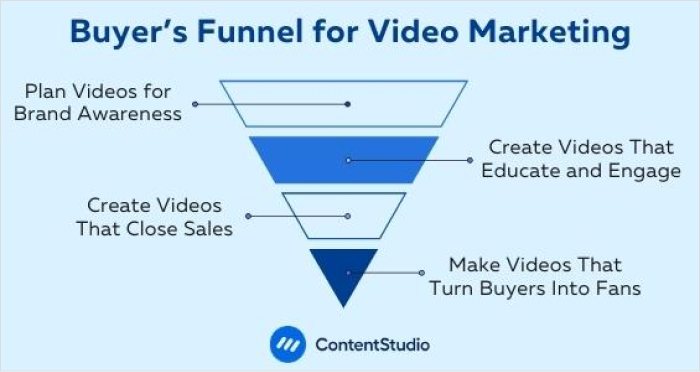
Stage #1: Plan videos for brand awareness
The top of your funnel is about reach and first impressions, where retail media networks and creator marketing strategies can amplify your brand’s visibility in the digital ecosystem. You want more people to know you exist and to start trusting your brand. The video is perfect here because it shows the human side of your company. For social media video marketing, create short videos that reflect your brand’s personality. Think Reels, Shorts, and TikToks that are under 30 seconds. Create how-to or explainer videos that hit a clear pain point for your target audience and position you as helpful, not pushy. Use vertical formats for Instagram, TikTok, and YouTube Shorts to match how people naturally watch on mobile.
Stage #2: Create videos that educate and engage
Once you’ve captured attention, your goal is to deepen interest and show how you solve real problems.
This calls for content that educates and nurtures relationships with prospects. Effective formats include webinars and live workshops, product demos and feature tours, customer case studies and success stories, in-depth explainer videos, and landing page videos that summarize key benefits.
Here’s an example from Evernote, which walks through how their Gmail integration works:
Treat this content as a bridge between marketing and sales. In B2B, these videos are often forwarded around internal buying committees.
Stage #3: Create videos that close sales
At this stage, your prospect is comparing options and looking for a low-risk decision.
You need videos that answer the question, “Why your product, and why now?”
Studies show that 74% of people who watched an explainer video about a product or service went on to buy it.
Useful formats here include product demos designed for specific use cases, short personalized videos from sales reps that highlight how your product helps that account, video testimonials and case studies with measurable results, and pricing and ROI breakdowns for stakeholders.For instance, this video shows how Slack and Salesforce work together:
Stage #4: Make videos that turn buyers into fans
An effective funnel doesn’t end at “Paid.” It continues into onboarding and retention.
Great post-purchase video content includes thank-you videos that feel personal, onboarding series that show how to get value fast, feature deep dives for power users, and educational mini-courses that sharpen your customer’s skills.
These videos lower support volume, reduce churn, and grow lifetime value by helping customers get more out of what they’ve already bought.
Read related: YouTube Algorithm
Key types of video marketing content (and when to use them)
Beyond funnel stages, it helps to know the main types of video marketing you can plug into your strategy.
Here are core formats and where they fit best:
- Explainer videos (Awareness/Consideration)
Short animated or live-action videos that answer “what you do” and “who you help.” Ideal for homepages and top-of-funnel ads. - Product videos and demos (Consideration/Decision)
Show your product in action and highlight features tied to specific outcomes. - Customer testimonials and case studies (Decision)
Real customers talking about real results. These build trust fast—especially for B2B buying teams. - How-to and tutorial videos (Consideration/Retention)
Step-by-step walkthroughs that teach people how to solve a problem or use your product. - Social videos (Awareness/Engagement)
Short, snackable clips designed for Reels, TikTok, LinkedIn, and YouTube Shorts. These power your social media video marketing engine. - Livestreams and webinars (Consideration/Engagement)
Real-time Q&As, product tours, AMAs, and interviews with subject-matter experts. - Event videos (Awareness/Engagement)
Recaps, highlight reels, or behind-the-scenes content from conferences, meetups, and launches. - Interview videos and panels (Awareness/Consideration)
Conversations with customers, partners, or thought leaders that build authority and trust. - Animated videos (Awareness/Consideration)
Great for explaining complex workflows, APIs, or abstract concepts in a simple visual way. - User-generated content (UGC) (Awareness/Decision)
Videos created by your customers and community. Think unboxings, reviews, and “day in the life with…” clips.
8 factors that make your video marketing strategy effective
So far, we’ve covered the what, why, and when of video. Now let’s talk about the “how” of building a video marketing strategy that actually supports revenue instead of just views.
Here are eight factors that separate high-performing strategies from random uploads.
1. Drafting a video campaign plan

Without a plan, your video efforts are just expensive guesses. Before you brief a videographer or open your camera app, map out a clear go-to-market plan for each campaign.
Apply the same thinking you use when preparing a content marketing plan for your audience.
Clarify:
- Goal
Assign a single, primary goal to each campaign or video: brand awareness, lead generation, product adoption, sales enablement, etc. Tie that goal to a funnel stage. - Target audience
Write down who you’re speaking to and what matters to them. Be specific about role, company size, industry, location, and interests. This helps you create the right video content in the right voice, with the right examples. - Buyer persona and use case
For B2B, map videos to real personas (e.g., “RevOps lead at a Series B SaaS”) and specific use cases, not generic “decision makers.” - Video type
Based on your goal, pick the video format: company culture videos, customer success stories, product review videos, feature explainers, webinars, or lo-fi screen recordings. For example, a new feature in your SaaS might need a snappy walkthrough like this one from ContentStudio:
- Medium / channel mix
Choose where each video lives based on audience behavior. For instance, 73% of adults in the US are active on YouTube, according to the Pew Research Center. A YouTube proxy can help you access region-specific content.
If your audience is mostly adults, YouTube is often a top channel. For B2B buyers, YouTube and LinkedIn work well together. Facebook still matters too 69% of adults use it. - Budget and resources
Even if you mostly shoot on phones, there are still costs: scripting, editing, motion graphics, paid media, and sometimes talent or studio time. Decide what you’ll do in-house and where you’ll bring in freelancers or agencies. - Publishing schedule
A strong plan includes a realistic publishing cadence. Viewers reward consistency. Use a calendar to map when and where you’ll publish.
Pro tip: Stay on top of your video posting schedule using ContentStudio to schedule, cross-post, and monitor performance across channels. - Key performance indicators (KPIs)
Pick KPIs that match your goal. If you want reach and engagement, your best KPIs to monitor are views, watch time, shares, and comments. If you care about pipeline, track demo requests, trial signups, and influence revenue. - Your video’s main selling point and creative angle
Decide what makes this video stand out: tone, story, visual style, or hook. Define your core message and the feeling you want viewers to take away. Keep this aligned with your brand voice.
While planning, run a quick competitor analysis. Create a simple spreadsheet, list 5–10 competitors, and note:
- Topics they cover and repeat
- Video formats they use (webinars, shorts, explainers, etc.)
- Posting frequency and main platforms
- Their signature style or angle
- Gaps you could fill
Keep your findings handy as you outline your video content strategy.
Finally, decide how you’ll repurpose your video content. About 60% of marketers reuse content two to five times. You should, too.
Examples:
- Turn a webinar into a blog post, email sequence, and a series of shorts.
- Extract key ideas into a visual carousel or infographic.
A good example is Ross Simmonds, who covers content distribution on Foundation Inc. He explains the topic in a video and a detailed blog post.
Build Trust with Curated Content
Discover, brand, and share the best content with your audience. Establish yourself as an authority and turn leads into loyal customers.
14 days free trial - no credit card required2. Pay attention to the scripting

AA strong script is the backbone of any effective video. Without it, even great footage falls flat.
Words and visuals work together to capture and hold attention. Weak in either area, and you risk losing viewers in seconds.
If you can, hire a scriptwriter with marketing experience. If not, you can write solid scripts yourself with a process. Start with an outline. Writing a video script outline is similar to writing an outline for other content, like blog posts.
When writing a video script outline, begin by drafting several working titles and selecting one to guide your writing. Next, jot down the main points so you know exactly what you must cover. Write in a conversational style using “you,” short sentences, and real-world examples. If that feels challenging, record yourself explaining the topic out loud, then transcribe and edit the recording. Finally, edit ruthlessly by removing repetition, filler phrases like “in order to,” “basically,” or “um,” and any jargon your audience doesn’t use.
Pay special attention to your hook in the first 3–5 seconds. That’s where viewers decide whether to keep watching.
Your hook should clearly call out your audience or problem, promise a specific outcome, and avoid generic intros like “Hey guys, welcome back.”
In 2026, you can also use AI-assisted tools to draft script options, test alternate hooks, and summarize long content into shorter video ideas. Just treat them as assistants, not final writers
3. Focus on storytelling
It’s tempting to put your product front and center in every video. That usually leads to content that feels like a pitch, not a story.
People connect with stories about people like them.Research shows that 80% of people prefer brands that tell stories in their marketing. Wave.video’s findings also show storytelling is the most popular video ad type among businesses.
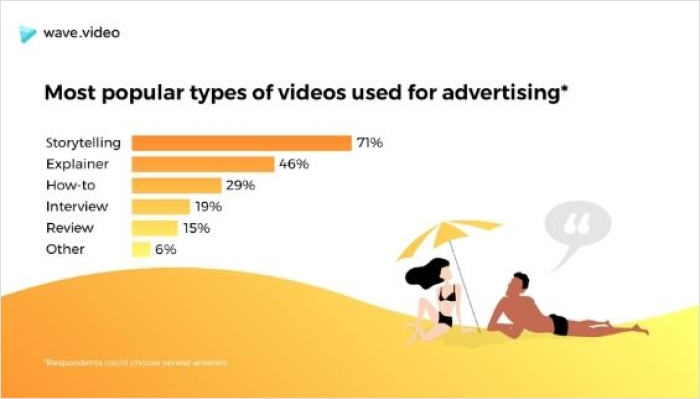
Thus, you need to draw a line between creating salesy videos and videos that lean on storytelling. Give preference to the latter.
As a social media strategist, Mack Collier shares that one good way to tap into stories for video marketing is to focus on themes that align with your brand. He outlines, “This is the new model of digital content creation. Don’t focus on your product, focus on the ideas and themes that relate to your products.”
We also talked to Wave.video Director of Content Marketing, Olga Bedrina, for her take on leveraging storytelling for awesome videos. She shared, “Trigger emotions by visual components. Hook people with context. Your instruments here are colors, fonts, filters, and the overall environment you create in a video to translate a message.”
Plus, more tips:
- Make your story about your audience, not yourself. Take inspiration from Nike that talks about athletes
- Create stories that stir emotions. Triggering emotions from users is no easy feat and requires a firm understanding of your target audience. On a similar note, consider checking out GetVoIP’s EQ guide to learn how to leverage emotional intelligence to improve customer relations. These will help you bond with your audience
- Produce a story with a beginning, middle, and end, with the aim of using every opportunity to hold your viewer’s attention
- Show conflict and then give a solution. In other words, address your customer’s challenges and offer a solution for them
4. Don’t skip video SEO
Great content that no one can find doesn’t help much.
Video SEO makes your videos easier to discover, both on platforms like YouTube and in Google search results.
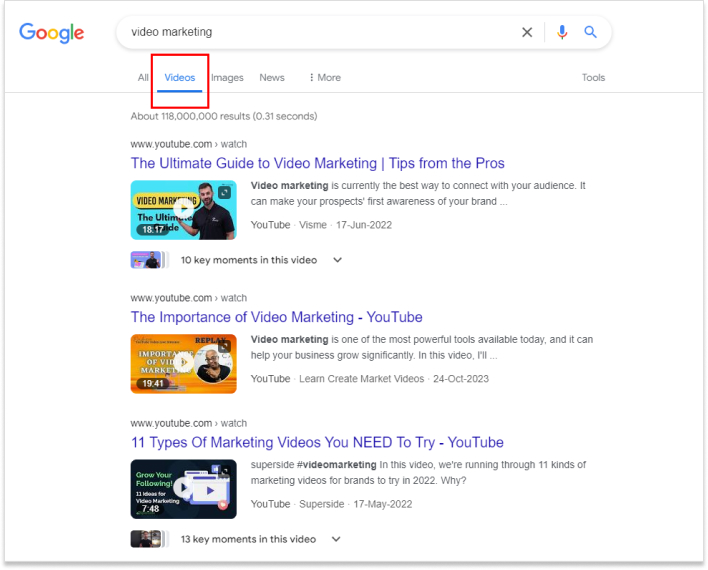
Here’s a full guide to video SEO, with a few core tips summarized:
- Add a video transcript
Captions let viewers watch even with sound off and act as indexable text for search engines. They also improve accessibility. - Choose an engaging thumbnail
Your thumbnail is your first impression. Custom human thumbnails have a 30% higher play rate than videos without a custom image. Show a face with emotion plus readable text. - Write keyword-aware titles and descriptions
Include your primary keyword once in your title and naturally in your description. Aim for ~150–250 words of description so algorithms can understand your topic. - Embed videos on relevant pages
Place each video on a page that has related copy. This gives search engines context and can help that page rank for more queries.
Use structured data where possible
If your team has dev resources, add video schema markup to help Google understand and feature your content.
5. Design for mobile and accessibility

Most video views now happen on phones. That makes mobile a non-negotiable part of your video marketing strategy.
When creating content, shoot and edit with small screens in mind using tight framing, readable text, and clear audio. Use vertical or square formats for Reels, TikTok, and Shorts. Avoid tiny on-screen text or cluttered designs that are hard to see on mobile.
Accessibility should also be a standard, not an afterthought. Add closed captions and transcripts to support people who are Deaf or hard of hearing, as well as everyone watching with the sound off. Use strong color contrast and readable fonts. Consider adding audio descriptions to key flagship videos when visuals alone may not convey the full story.
Netflix is a strong example: its content includes closed captions and audio descriptions for most titles, which improves the viewing experience for a global audience.
6. Use data and analytics wisely
Data is how you move from guessing to knowing.
Use analytics tools to track metrics such as views and impressions, watch time and average view duration, click-through rates on CTAs, and conversions, including signups, demos, and purchases.
Analyze performance by funnel stage, comparing awareness versus decision content. Look at the formatting differences between short and long-form videos. Examine platform variations across YouTube, LinkedIn, and TikTok. Break down results by audience segments like prospects versus customers.
A/B testing helps refine your approach. Test different thumbnails, titles, hooks, video lengths, and CTAs, along with end screens, to see what resonates.
In 2026, many platforms use machine learning to surface patterns you might miss, like drop-off points or topics that consistently outperform. Use these insights to refine your video content strategy over time.
7. Distribution and promotion
Creating high-quality videos is only half the work. Getting them seen by the right people is the other half.
Build a clear content distribution strategy to promote your videos across channels where your audience is active.
Focus on three buckets:
- Social media
Share videos on platforms such as Facebook, Instagram, X (formerly Twitter), LinkedIn, TikTok, and YouTube. Post natively rather than just sharing links, and tailor your edits, captions, and aspect ratios to each platform. - Email marketing
Add video to your campaigns to boost opens and clicks. Use static thumbnails or GIF previews linked to a landing page with the video embedded. - Website and landing pages
Embed videos on your homepage, product pages, feature pages, and blog posts. Thoughtful placement and fast load times are key for engagement and conversions.
For example, Red Bull’s video marketing strategy doesn’t rely on ads alone. The brand distributes content across social channels, events, and partnerships. By collaborating with athletes, musicians, and creators, they plug video into communities their audience already cares about.
8. Don’t compromise on video quality
Quality still matters. It shapes how people perceive your brand.
Research from Brightcove shows that 62% of consumers are likely to form a negative view of a brand if they see poor-quality videos. 60% won’t engage with that brand at all, which can do more damage than not using video.
Verizon Digital Media Services (VDMS) surveyed about 1,000 adult internet users and found that average viewing time fell by 77% when video quality was poor. Over 85% expected TV-level quality from online videos, and about 25% said they chose not to watch a video due to poor quality at least half the time in a given month.
Takeaway: aim for clear visuals, crisp audio, and stable footage. That doesn’t always mean big-budget productions, just a strong baseline.
To improve quality, use video editing software to enhance color, audio, and transitions. Adjust contrast, saturation, hue, and brightness to get a consistent look. Use noise reduction to clean up grainy or low-light footage. If needed, hire someone to create good-quality videos or coach your team.
In 2026, good-enough phone footage with clear framing and audio often beats overproduced content that feels stiff. Aim for professional but human.
Video production process for a modern video content strategy
A reliable video marketing strategy also needs a simple, repeatable production workflow. Think in three stages: pre-production, production, and post-production.
Pre-production: plan before you hit record
Pre-production involves making major decisions. First, clarify the concept: the video’s purpose, target audience, and content. Then, develop a script and outline, aiming for 120–150 words in a one-minute video. Use storyboards, even rough sketches, to visualize shots and transitions. Plan logistics by scheduling shoot days, booking locations, confirming speakers or hosts, and gathering props. For small teams, a brief, bullet-point script, and basic shot list suffice.
Production: capture strong footage
On shoot day, even if it’s just you and your phone, use a tripod or stabilizer to avoid shaky footage. Prioritize audio by investing in a lavalier or USB mic if you do a lot of talking-head clips. Check the background, remove distractions, and keep it on-brand.
Shoot extra b-roll, such as screens, hands on a keyboard, office shots, and product close-ups. This stockpile will help future edits, social cuts, and promo video that support your broader video content marketing strategy.
If you work with creators or subject-matter experts remotely, ship them simple recording kits or share best practices to ensure consistent quality across your video content marketing strategy.
How to adapt your video marketing strategy for B2B
B2B buyers binge content just like consumers, but their decisions are higher stakes and more complex. That means your b2b video marketing strategy should support long sales cycles and buying committees.
Focus on:
- Thought leadership and education
Regular LinkedIn videos, podcast clips, and webinars that show your expertise and point of view. - Problem-focused explainers
Videos that start with a clear business problem and then show how your product solves it. - Sales enablement content
Short explainer clips, ROI breakdowns, and objection-handling videos that reps can drop into email or Slack threads. - Multi-stakeholder paths
For each core persona (user, manager, executive), create videos that speak to their concerns: workflow, team performance, or business outcomes. - Account-based video
For high-value accounts, create custom intros, micro-case studies, or short Loom-style walkthroughs of their specific setup or opportunity.
Distribution-wise, LinkedIn, YouTube, and email are usually your core B2B channels, with X and niche communities as secondary outlets.
Simple tips for creating engaging videos
Although there are numerous tips already sprinkled throughout the previous section, we couldn’t leave you without four more important tips. So let’s continue:
- Get straight to the meat of things
It takes viewers less than 10 seconds to decide if your video is worth their time or not. One-fifth of them click away within this duration. Your role, therefore, is to tell your audience immediately why they should watch your video. Ask them a question or tell them what they’ll learn.
- Include captions in your videos
Not only is a video transcript healthy for your video SEO, but it also makes it convenient for viewers to watch your videos, considering 85% of Facebook videos are viewed without sound.
Intrigued by such a stat, the Social Media Manager at Instapage tracked captions and without caption metrics on Instapage’s videos for two months. Altogether, the data was pooled from more than 10,000 watchers.
Here’s the complete study with a few relevant takeaways below:
- With captions, the average total view time was 5% higher, andit got 3% more viewers
- With captions, the average reach was 16% higher than without captions
- Captioned videos also got higher reactions by an average 17% in contrast with videos without captions
- The number of average shares decreased by about 15% when captions were removed
- Add a call to action
A call to action is an action message comprising of a few words that encourage the audience to take action. It tells interested leads what to do next. Adding such a CTA in a video can generate as many as 65% more clicks than a CTA present on the sidebar on the same page.
Conclusion
Building an effective video marketing strategy in 2026 means going beyond one-off uploads.
When you set clear goals for each video, match formats to funnel stages and platforms, use storytelling instead of just feature lists, plan production with mobile, accessibility, and quality in mind, and distribute thoughtfully while measuring what matters, video becomes a reliable growth channel for your brand.
Whether you’re a SaaS team, agency, or e-commerce brand, a modern video content marketing strategy blends creativity with data. Stay curious about new formats like short-form, vertical, and creator-led content, use helpful AI tools, and keep listening to your audience.
That’s how your video marketing strategy stays relevant, effective, and ready for whatever comes next.
FAQs
How can I measure the success of my video marketing strategy?
Measure success by tracking metrics tied to your goals and funnel stages:
- Awareness: views, impressions, reach, brand lift
- Engagement: watch time, average view duration, comments, shares
- Conversion: click-through rates, demo requests, signups, purchases
- Retention: repeat visits, product usage, renewal, and expansion rates
Combine platform analytics with tools like Google Analytics and your CRM to tie video views to pipeline and revenue. You can also run surveys or collect feedback from your audience for qualitative insights.
What types of videos are most effective for marketing purposes?
The best formats depend on your goals, target audience, and stage in the customer path. That said, consistently strong performers include:
- Product demos and walkthroughs
- Customer testimonials and case studies
- Educational or how-to videos
- Short-form social clips (Reels, TikToks, Shorts)
- Behind-the-scenes and culture videos for the employer brand
- Webinars and live Q&A sessions
Mix formats into your video marketing strategy to support awareness, consideration, decision-making, and retention.
How often should I publish video content?
The frequency of your video content depends on:
- Your resources and team size
- Audience expectations on each platform
- The complexity of your videos (quick clips vs. full productions)
Aim for a consistent schedule you can maintain for months, not weeks. For many brands, that might be:
- 2–5 short-form social videos per week
- 1–2 YouTube videos per month
- 1 webinar or livestream per quarter
What budget do I need for video marketing?
Video marketing budgets vary by quality and scope. Small businesses often spend $1,000-$10,000 per month, while larger firms spend more on equipment, software, talent, editing, and promotion. Start small and scale with results.
Do I need expensive equipment to create marketing videos?
No, you do not need expensive equipment to start. Modern smartphones shoot high-quality video that works perfectly for social media and many marketing purposes. Essential budget-friendly items include:
- A smartphone with a good camera
- A basic tripod or stabilizer
- Natural lighting or affordable ring lights
- Free or low-cost editing software
Focus on compelling content and clear audio first. You can upgrade equipment as your skills and budget grow.
Recommended for you











Powerful social media management software
7-day free trial - No credit card required.